
Hey there, farm family!
Winter has settled over our Southeast Michigan homestead at Lange Girl Farms, and Misty Thunderstorm—Misty for short—is looking round and radiant on her dry lot. Our little black-and-white paint mini mare, bred back on June 2025, is carrying a foal due around May 2026. Feeding her right is one of the most important things we do every day. We’ve learned through trial and error on the farm that nutrition for a pregnant mini mare is all about balance and quality. Too much, and you risk obesity or complications; too little, and the foal doesn’t thrive. Misty’s on a dry lot year-round, so every bite comes from locally sourced, fescue-free timothy hay from trusted Southeast Michigan farmers—that fresh, sweet hay is everything for minis.
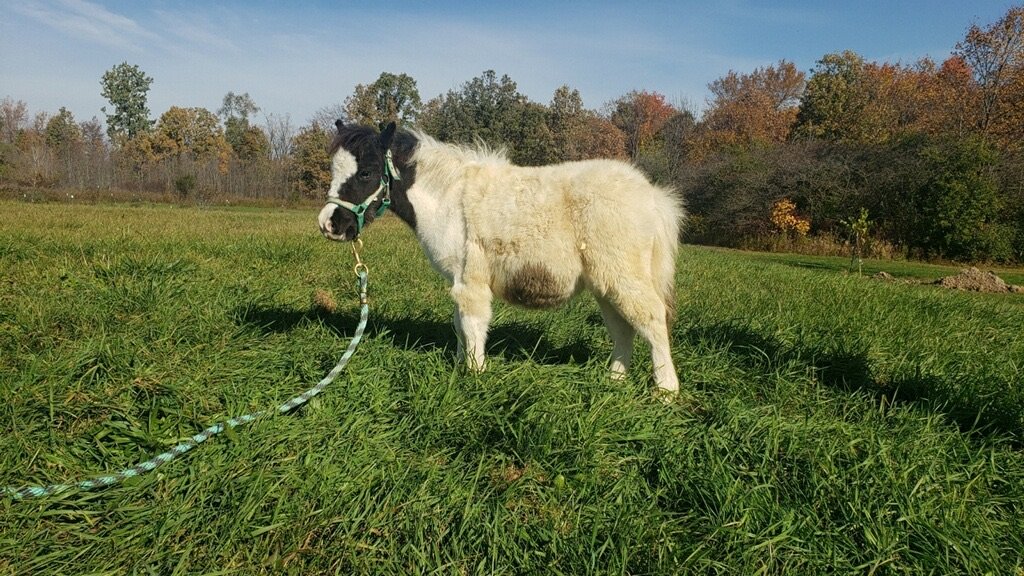
This guide walks you through Misty’s full nutritional plan from early pregnancy through lactation, how we source and test feed, and the practical tips we use every day. At Lange Girl Farms, we lean on our human salves like Bumps & Bruises Balm for everyday aches, and we’re testing livestock blends too—stay tuned for those! So grab a hot cocoa, pull up a hay bale, and let’s talk about feeding Misty for her mini foal.
Why Nutrition Is Everything for a Pregnant Mini Like Misty
Miniature horses have fast metabolisms and small digestive systems, so pregnancy nutrition needs precision. Misty’s 200-lb frame can’t handle the same portions as a big horse—overfeeding leads to obesity, hyperlipemia, or laminitis, while underfeeding risks weak foals. We base her plan on equine research and what we’ve learned right here on the farm, adjusted for minis’ unique needs. On her dry lot, we control every bite to prevent pasture overgrazing issues, and we prioritize locally sourced hay because quality matters more than quantity for minis.
Misty’s Stage-by-Stage Nutritional Plan
Here’s Misty’s detailed feeding plan, tailored for a 200-lb pregnant mini mare on a dry lot. We split meals into 2–3 daily to mimic natural grazing and prevent colic.
• Early Pregnancy (July–September 2025): Misty’s needs are close to maintenance, with a gentle boost for the embryo. Feed 3–4 lbs locally sourced timothy hay (8–10% protein, 0.9 Mcal/lb DE) and 0.5–1 lb Purina Equine Senior, split into two meals. Add 1 oz Farnam Mare Plus for vitamins and a Champion’s Choice White Salt Block for minerals.
Nutrient Targets: Energy 3.8–4.2 Mcal/day, Protein 0.4–0.5 lbs/day, Calcium 4–5 g/day, Phosphorus 3–4 g/day.
• Mid-Pregnancy (October–December 2025): Fetal growth ramps up. Increase hay to 3.5–4.5 lbs and switch to 1–1.5 lbs Nutrena SafeChoice Mare & Foal or Purina Impact All Stages 14%, split into three meals. Add 1 oz SmartMare Harmony and 0.5 oz Omega Horseshine.
Nutrient Targets: Energy 4.2–4.8 Mcal/day, Protein 0.5–0.6 lbs/day, Calcium 5–7 g/day, Phosphorus 4–5 g/day.
• Late Pregnancy (January–April 2026): The foal gains 60–70% of its birth weight, so nutrient demands rise. Feed 4–5 lbs hay and 1.5–2 lbs of a 14–16% protein broodmare feed such as Buckeye Mare & Foal, Purina Omolene 300 Mare & Foal, or Purina Impact All Stages 14%, split into three meals. Continue SmartMare Harmony and increase Omega Horseshine to 1 oz.
Nutrient Targets: Energy 4.8–5.5 Mcal/day, Protein 0.6–0.8 lbs/day, Calcium 8–10 g/day, Phosphorus 5–6 g/day.
• Pre-Foaling (April–May 2026): Energy needs peak as Misty prepares for labor. Maintain 4–5 lbs hay and increase to 2–2.5 lbs of the same 14–16% broodmare feed, adding Farnam Apple Elite if needed for extra calcium.
Nutrient Targets: Energy 5.0–5.8 Mcal/day, Protein 0.8–1.0 lbs/day, Calcium 10–12 g/day, Phosphorus 6–7 g/day.
• Lactation (May 2026+): Milk production doubles Misty’s needs. Feed 5–6 lbs hay and 2.5–3 lbs Buckeye Ultimate Finish 25 or similar high-energy feed, split into three meals.
Nutrient Targets: Energy 7.0–8.5 Mcal/day, Protein 1.0–1.2 lbs/day, Calcium 12–15 g/day, Phosphorus 7–9 g/day.
We weigh every flake with our Digital Scale because minis can’t handle guesswork. Water is always fresh, warmed in winter with a Little Giant Heated Bucket to encourage drinking.
Sourcing Hay and Feed Locally
Misty’s dry lot means hay is her main forage, and we source fescue-free timothy from trusted Southeast Michigan farmers to ensure top quality. Local hay is fresher, supports our neighbors, and avoids fescue risks. We connect with local farmers for consistent supply. Soak hay 10–15 minutes in a Weaver Leather Hay Net to reduce dust.
Holistic Care for Misty
Misty’s coat is gleaming this winter, but for any rubs from her growing belly, we’re ready with our Bumps & Bruises Balm. We’re also testing livestock-specific salves like a Healing Livestock Salve for minor scrapes—stay tuned! We’ll share salve-making recipes in future blogs.
Tips & Tricks from the Barn
Here are 8 practical tips to feed your pregnant mini mare:
• Weigh every flake of hay—minis can’t handle guesswork.
• Soak hay 10–15 minutes to reduce dust.
• Test your hay with Equi-Analytical for 8–10% protein and no fescue.
• Split meals into 2–3 feedings to prevent colic.
• Monitor BCS every two weeks with a Cargill Equine Weight Tape—aim for 5–6/9.
• Source hay from local farmers you trust and ask for test results.
• Warm water in winter to encourage drinking.
• Go natural—our Bumps & Bruises Balm soothes human skin from barn work, and we’re testing livestock salves—stay tuned!
Wrapping Up
Feeding Misty through her pregnancy is important work at Lange Girl Farms, and with local hay, precise measurements, and homestead know-how, she’s thriving for her May foal. We hope this guide helps y’all keep your mini mares happy and healthy too. Soothe winter skin with our Bumps & Bruises Balm, and stay tuned for our livestock salves like Healing Livestock Salve, coming soon. Join our farm family—share your mini feeding tips in the comments or follow @langegirlfarms on Instagram for Misty’s next steps and future recipe posts! 🌾🐎
Affiliate Disclosure: This post contains affiliate links. If you make a purchase through these links, I may receive a small commission at no extra cost to you!